Download PDF The Lost History of Christianity: The Thousand-Year Golden Age of the Church in the Middle East, Africa, and Asia--and How It Died, by Phi
Why need to be reading The Lost History Of Christianity: The Thousand-Year Golden Age Of The Church In The Middle East, Africa, And Asia--and How It Died, By Phi Once more, it will certainly depend upon how you feel and also consider it. It is certainly that a person of the benefit to take when reading this The Lost History Of Christianity: The Thousand-Year Golden Age Of The Church In The Middle East, Africa, And Asia--and How It Died, By Phi; you could take more lessons straight. Even you have actually not undertaken it in your life; you could get the experience by reading The Lost History Of Christianity: The Thousand-Year Golden Age Of The Church In The Middle East, Africa, And Asia--and How It Died, By Phi As well as now, we will present you with the online book The Lost History Of Christianity: The Thousand-Year Golden Age Of The Church In The Middle East, Africa, And Asia--and How It Died, By Phi in this internet site.
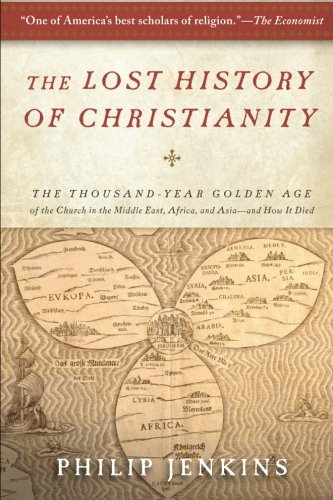
The Lost History of Christianity: The Thousand-Year Golden Age of the Church in the Middle East, Africa, and Asia--and How It Died, by Phi

Download PDF The Lost History of Christianity: The Thousand-Year Golden Age of the Church in the Middle East, Africa, and Asia--and How It Died, by Phi
The Lost History Of Christianity: The Thousand-Year Golden Age Of The Church In The Middle East, Africa, And Asia--and How It Died, By Phi When composing can change your life, when composing can enrich you by providing much cash, why don't you try it? Are you still really baffled of where getting the ideas? Do you still have no suggestion with just what you are visiting create? Currently, you will require reading The Lost History Of Christianity: The Thousand-Year Golden Age Of The Church In The Middle East, Africa, And Asia--and How It Died, By Phi A good author is a great user simultaneously. You can define exactly how you create depending on what publications to read. This The Lost History Of Christianity: The Thousand-Year Golden Age Of The Church In The Middle East, Africa, And Asia--and How It Died, By Phi could aid you to solve the issue. It can be one of the right sources to develop your creating skill.
As one of the window to open the new world, this The Lost History Of Christianity: The Thousand-Year Golden Age Of The Church In The Middle East, Africa, And Asia--and How It Died, By Phi supplies its fantastic writing from the author. Published in one of the preferred publishers, this publication The Lost History Of Christianity: The Thousand-Year Golden Age Of The Church In The Middle East, Africa, And Asia--and How It Died, By Phi becomes one of the most ideal publications just recently. Actually, the book will certainly not matter if that The Lost History Of Christianity: The Thousand-Year Golden Age Of The Church In The Middle East, Africa, And Asia--and How It Died, By Phi is a best seller or not. Every book will always give ideal resources to get the viewers all finest.
Nonetheless, some individuals will seek for the very best seller publication to read as the first referral. This is why; this The Lost History Of Christianity: The Thousand-Year Golden Age Of The Church In The Middle East, Africa, And Asia--and How It Died, By Phi is presented to fulfil your necessity. Some people like reading this book The Lost History Of Christianity: The Thousand-Year Golden Age Of The Church In The Middle East, Africa, And Asia--and How It Died, By Phi as a result of this preferred book, yet some love this because of favourite author. Or, many additionally like reading this book The Lost History Of Christianity: The Thousand-Year Golden Age Of The Church In The Middle East, Africa, And Asia--and How It Died, By Phi considering that they truly should read this publication. It can be the one that really love reading.
In getting this The Lost History Of Christianity: The Thousand-Year Golden Age Of The Church In The Middle East, Africa, And Asia--and How It Died, By Phi, you could not constantly go by strolling or using your motors to the book stores. Obtain the queuing, under the rainfall or hot light, and still search for the unidentified publication to be in that book shop. By visiting this web page, you can only hunt for the The Lost History Of Christianity: The Thousand-Year Golden Age Of The Church In The Middle East, Africa, And Asia--and How It Died, By Phi and also you could locate it. So now, this time is for you to go with the download link as well as acquisition The Lost History Of Christianity: The Thousand-Year Golden Age Of The Church In The Middle East, Africa, And Asia--and How It Died, By Phi as your very own soft data publication. You could read this publication The Lost History Of Christianity: The Thousand-Year Golden Age Of The Church In The Middle East, Africa, And Asia--and How It Died, By Phi in soft data only as well as wait as yours. So, you don't have to fast put the book The Lost History Of Christianity: The Thousand-Year Golden Age Of The Church In The Middle East, Africa, And Asia--and How It Died, By Phi into your bag anywhere.
“Jenkins is one of America’s top religious scholars.”
�—Forbes magazine
The Lost History of Christianity by Philip Jenkins offers a revolutionary view of the history of the Christian church. Subtitled “The Thousand-Year Golden Age of the Church in the Middle East, Africa, and Asia—and How It Died,” it explores the extinction of the earliest, most influential Christian churches of China, India, and the Middle East, which held the closest historical links to Jesus and were the dominant expression of Christianity throughout its first millennium. The remarkable true story of the demise of the institution that shaped both Asia and Christianity as we know them today, The Lost History of Christianity is a controversial and important work of religious scholarship that sounds a warning that must be heeded.
- Sales Rank: #70253 in Books
- Brand: Jenkins, Philip
- Published on: 2009-11-03
- Released on: 2009-11-03
- Original language: English
- Number of items: 1
- Dimensions: 8.00" h x .76" w x 5.31" l, .54 pounds
- Binding: Paperback
- 336 pages
From Publishers Weekly
Starred Review. Revisionist history is always great fun, and never more so than when it is persuasively and cogently argued. Jenkins, the Penn State history professor whose book The Next Christendom made waves several years ago, argues that it's not exactly a new thing that Christianity is making terrific inroads in Asia and Africa. A thousand years ago, those continents were more Christian than Europe, and Asian Christianity in particular was the locus of tremendous innovations in mysticism, monasticism, theology and secular knowledge. The little-told story of Christianity's decline in those two continents—hastened by Mongol invasions, the rise of Islam and Buddhism, and internecine quarrels—is sensitively and imaginatively rendered. Jenkins sometimes challenges the assertions of other scholars, including Karen Armstrong and Elaine Pagels, but provides compelling evidence for his views. The book is marvelously accessible for the lay reader and replete with fascinating details to help personalize the ambitious sweep of global history Jenkins undertakes. This is an important counterweight to previous histories that have focused almost exclusively on Christianity in the West. (Nov.)
Copyright � Reed Business Information, a division of Reed Elsevier Inc. All rights reserved.
From Booklist
*Starred Review* Jenkins turns from the recent history and trend projections of such invaluable books as The Next Christendom (2002) and God’s Continent (2007) to a much broader canvas, roughly from the fifth century to the twentieth, within which the first global Christian establishment persisted for a thousand years. The predominant churches of that establishment were Nestorian and Jacobite, sufficiently different in conceptions of the nature of Christ to be considered heretical by Catholics and Orthodox. They consisted of hundreds of bishoprics from Egypt and Abyssinia to India and China, with the greatest concentration in Mesopotamia.�For centuries, they got along well with neighbor faiths, especially Islam. But the pressure of invaders into Islamic-ruled lands, from the East (Mongols and Turks) even more devastatingly than from the West (the Crusades), and the fact that Christians often allied with those invaders, eventually provoked savage reaction from Muslims, especially, and, most lethally, from Islamicized Turks. So secular politics tolled the long death knell of Nestorian-Jacobite Christianity.�In leaner, clearer prose than ever before, Jenkins outlines and analyzes this history, which few present-day Christians have even heard of. This may be the most eye-opening history book of the year. --Ray Olson
Review
“Jenkins is one of America’s top religious scholars.” (Forbes)
“. . . persuasively and cogently argued . . . marvelously accessible for the lay reader and replete with fascinating details to help personalize the ambitious sweep of global history Jenkins undertakes. This is an important counterweight to previous histories that have focused almost exclusively on Christianity in the West.” (Publishers Weekly, starred review)
“In leaner, clearer prose than ever before, Jenkins outlines and analyzes this history, which few present-day Christians have even heard of. This may be the most eye-opening history book of the year.” (Booklist)
“Philip Jenkins’ book is a tour de force in historical retrieval and reconstruction, a work of scholarly restoration that strikes an overdue balance in the story of Christianity. It is studded with insight, with the story presented in a lively and lucid style.” (Lamin Sanneh, Professor of World Christianity and Professor of History, Yale University)
“Philip Jenkins always writes well on very interesting topics. This time his topic is more than interesting-it is essential reading for anyone with any interest in the history of Christianity.” (Rodney Stark, author of The Rise of Christianity)
“...an exceptionally fine study of a great swathe of Christian history, hugely important in the Christian story but very little known. This thoughtful, elegant and learned survey will remedy the neglect of a subject which students of religion absolutely need to know about.” (Diarmaid MacCulloch, Professor of the History of the Church, University of Oxford and author of The Reformation)
“In this highly readable and sobering exploration of how religions - including our own - grow, falter and sometimes die, Jenkins adds a unique dimension to present day religious studies in a voice and style that non-specialists can also appreciate.” (Harvey Cox, Hollis Professor of Divinity, Harvard University)
“[Jenkins’] depiction of the long Christian history of Asia, Mesopotamia, and the greater Middle East is both a much-needed education and a spiritually fruitful provocation.” (Books & Culture)
“The Lost History of Christianity is a fascinating study of the first thousand-plus years of the Church--a Church rooted in the Middle East, Africa, and Asia. We have much to learn from the tale of its reach, its particular way of being Christian, and its eventual decomposition ” (Beliefnet.com (One of the Best Religious Books of 2008))
“Using his skill to discredit murky thinking and propose new understandings where the old no longer serve a good purpose, Jenkins offers yet another jewel in what is becoming a crown of paradigm-shattering studies. [This book] will amply reward your investment of time and attention.” (America)
“Philip Jenkins’s marvelous new book...tells the largely forgotten story of Nisibis, and thousands of sites like it, which stretch from Morocco to Kenya to India to China, and which were, deep into the second millennium, the heart of the church.” (The Weekly Standard)
“Jenkins’s well-crafted new volume...is not only a welcome addition to the literature on Christianity as a truly global religion, to which he has already made substantial contributions, but also an invitation to retrieve a forgotten chapter of history that has not inconsiderable relevance to current events.” (Religion & Ethics Newsweekly)
Most helpful customer reviews
138 of 144 people found the following review helpful.
Very Helpful, Few Reservations
By Matt K.
"The best reason for the serious study of history," writes Philip Jenkins in The Lost History of Christianity, "is that virtually everyone uses the past in everyday discourse. But the historical record on which they draw is abundantly littered with...half-truths...Historians can, or should, provide a corrective for this" (43). For Jenkins, the history of Christianity is especially susceptible to half-truths which highlight the connection of Christianity to Europe, and its role in promoting colonialism and intolerance. Besides oversimplifying its European sojourn, such presentations ignore the long history of the faith in Africa and Asia. Recovering the one-time splendor and eventual destruction of this ancient non-western Christianity is the "corrective" task Jenkins sets for himself in this timely study.
For most of its history, "Christianity has been a tricontinental religion, with powerful representation in Europe, Africa and Asia." (3). Well into the 14th century, eastern Christian groups like the Nestorians and Jacobites spread deep into the Middle East and Central Asia, as far as China and India, where they produced a richness of Christian scholarship, mysticism and culture which was not widespread in Europe until much later. Today, we tend to think that of the Middle East, North Africa and Central Asia as inevitably Muslim. But a thousand years ago, despite the political success of Islam, Christianity appeared poised to continue as the dominant faith of these regions. This raises the question: what happened? It is here that Jenkins is most insightful. Politically, he points out how the coming of the Muslims probably appeared more as an "Arab conquest": one more in a string of empires under which the Christians could live. After all was not "the Church an anvil that has worn out many a hammer?" (207). It was several factors which produced a "new Muslim hostility" (134) through which these regions were decisively Islamized (and Dechristianized). Jenkins notes, for instance, the Mongol invasions, and also to the economic effects of "The Little Age" of the 12th and 13th centuries. Facing such threats, Muslims began to more actively persecute their Christian subjects and neighbors.
This was the "first stage" of decline. Here, Christians lost majority status and struggled against increasing discrimination. In the ongoing "second stage," things deteriorated further, to the extent that these churches "have ceased to exist altogether" (141). Facing the rise of Europe, Muslim regimes (like the Ottomans), and Muslim societies in general, engaged in persecution of Christians throughout the now increasingly "Muslim world." In fact, the word "genocide" was coined with reference to the anti-Christian purges against the Armenians and Syrians in the 20th century. Jenkins summarizes: "For all the reasons we can suggest for the...[Christian] decline...the largest single factor...was organized violence, whether in the form of massacre, expulsion, or forced migration" (141).
These are the main lines of Jenkins' study, but there are four areas that deserve further comment. First, Jenkins helpfully draws implications from his study for the work of scholars like Elaine Pagels and Bart Ehrmann, who have sought to rehabilitate early Gnostic writings as containing legitimate "alternative Christianities;" Christianities which were supposedly suppressed by the church. Jenkins, however, remains unconvinced: "The... conservatism of these [eastern] churches, so far removed from papal or imperial control, makes nonsense of claims that the church...allied with empire to suppress unpleasant truths about Christian origins" (88).
Second, recognizing the delicacy of the subject, Jenkins is generally successful in striking the balance between the violence and tolerance Islamic history. On one hand, he takes to task thinkers like Karen Armstrong who selectively accentuate the benevolent side of Islam. He writes, "It is astonishing...how readily the myth of Muslim tolerance has been accepted...the story...involves far more active persecution...than would be suggested by...believers in Islamic tolerance" (33, 99). On the other hand, he makes clear that the violence perpetrated by Muslims is similar to that perpetrated by other groups, including the church. Moreover, he makes clear that the many historical examples of Islamic tolerance, especially the "benevolent nature of Muslim rule during its first 6 centuries" (33), should not be overlooked. In this connection, Jenkins is also to be commended for showing how often there were non-religious factors that led to violence.
However, it is one thing to note such factors, but quite another to virtually exclude religious factors. Jenkins writes, "Nothing in Muslim scriptures makes...Islam more or less likely to engage in persecution...The scriptures of Islam include...fewer calls to blood-curdling violence than do their Christian and Jewish counterparts...Violence [derives] not from anything inherent in Islam..." (31, 242). In response, it must be pointed out that these undocumented assertions are not empirical findings as much as personal opinions. In fact, a good case can be made that the canonical texts of Islam have also done their part to contribute to Muslim violence (for example, see David Cook's Understanding Jihad (Berkeley: University of California Press, 2005)). As for the "calls to blood-curdling violence" in the Hebrew Bible, the broad consensus among Christians is that these calls have been superseded by the non-violence of New Testament. In contrast, as Cook points out, there does not yet seem to be a comparable Muslim consensus.
Third, with tantalizing brevity, Jenkins deals with the impact of eastern churches on Islam (36-39, 173-206). The architecture of mosques, the "Muslim" style of prayer, the practice of Sufism, and many elements in the Qur'an itself may preserve "ghosts" of these churches. In fact, it was not initially Muslims, but largely eastern Christians (under eventual Muslim patronage) who preserved the intellectual heritage of the ancient world by translating it into Arabic: "Such were the Christian roots of the Arabic golden age" (19). Jenkins' study is quite helpful at this point since this is an under-explored field today. While Syrian and Arab Christians at the time of Islam's birth certainly saw the parallels, and while scholars from a century ago (largely ignored by Jenkins), wrote of the Christian influence on Islam, there seem to be fewer today exploring this nexus (though Jenkins mentions Christoph Luxenberg - p. 186). In light of this, Jenkins study usefully suggests that by studying Islamic origins, we can recover something of these ancient churches; and by studying these churches, we can recover something of Islam.
From this, however, Jenkins perhaps too-predictably calls for "a closer dialogue between the sister faiths," (39) along with the suggestion that Christians should see Islam as "another form of divine revelation, one that complements but does not replace the Christian message" (258). While it is true that Jenkins' study uncovers "deep historical linkages" between the two faiths, it must be remembered that genuine dialogue will not emphasize these linkages alone. Genuine dialogue must also note (with irenic spirit) the central points at which the two faiths are quite un-complementary.
Finally, in his last chapter, Jenkins tiptoes into a theological consideration of the extermination of the eastern churches. If we can overlook his too-facile rejection of the biblical idea that the suffering of God's people may be due in part to God's judgment (252), we will find here much fertile ground for reflection. He is right to point out that, in contrast to unbiblical visions of a politically dominant Christianity, or a prosperity gospel, the New Testament teaches Christians to expect suffering. Jenkins' work is thus a call for the recovery of a cross-centered theology. As well, since the Bible harbors a "deep suspicion about the secular order" and underlines the "transience of human affairs" ("Even the Roman Empire was not to last forever," 260), Christians should see "the foolishness of associating faith with any particular state or social order" (262). Finally, Jenkins reminds us that in spite of everything, Christianity "is today the world's most numerous religion." Indeed, taking both the Bible and history as paradigms, Jenkins' study is a reminder that a theology of suffering must be held as preliminary to a theology of survival, and ultimately to a theology of resurrection.
138 of 148 people found the following review helpful.
A Great Story That Needs a Better Book
By Timothy Haugh
I was very excited when I started reading this book. It's topic is very interesting; namely, that, though the Western model of Christianity is currently dominant, for a thousand years after the flowering of Christianity, the Christian churches of Asia and Africa were as powerful and influential (and in some cases, more so) as the Western church, and it is only through the chances of history that these churches have been sidelined or, in some cases, completely wiped out. And certainly, though it may serve our (that is, Western Christians') vanity to think that our success was pre-ordained, very small historical changes could have made the modern world look very different.
To his credit, throughout the book, Jenkins does manage to make a number of interesting points. Early on, his descriptions of the spread of Eastern Christianity all the way to China and Japan, and his extensive quotations from now forgotten patriarchs of churches often considered heretical today (Nestorians, Jacobites) give vivid credence to his arguments. I was also very taken with his argument of how churches have to make there way "into the villages" in order to survive oppression. For example, the great St. Augustine once led a vibrant North African church from Carthage, yet his urban-oriented church could not survive the spread of Islam whereas the penetrating Coptic churches of Egypt still manage to hang on after over 1000 years of Islamic rule.
On the other hand, Jenkins' book suffers from nearly debilitating weaknesses. First, his prose is surprisingly dull for the story he is telling. His prose could also use some tightening, in the sense that he wanders around the world and among now forgotten religions and leaders with a casualness that can be difficult for those not already familiar with these rather obscure topics and people. Finally, his focus on the relationship between Christianity and Islam in the latter chapters is somewhat of a disappointment when he hints and more interesting thing in India, China and the Far East, which doesn't get equal treatment. Certainly, his focus on the controversial idea that Islam is nothing more than a perverted Christianity seems to serve no real purpose here, other than to try to give energy to a flagging story.
Ultimately, I liked very much the story Jenkins was trying to tell. The history of the lost Christian churches of Africa and Asia is one that deserves to be told, if for no other reason that to modify the Euro-centric ideas of Christianity we have now. I just wish he could have told it much better. Perhaps someone in the future will write a more focused, comprehensible version of this book. That is a book I'd be anxious to read.
1 of 1 people found the following review helpful.
Jenkins reveals a larger and longer Christian history
By Vern Hyndman
The Lost History of Christianity
I suffered the myopia of a short sighted history before reading “The Lost History of Christianity”. Philip Jenkins does a scholarly and masterful job of expanding the truth of the history of Christianity, and in doing so, reminds us of the way that the Church works in a murderous world. I took a recent trip to Turkey, exploring the conflict between Christians and Muslims and the genocide of Armenian Christians at the turn of the last century. I became aware that the church grows over centuries based on the blood of the martyrs, not on the edge go the sword.
First Jenkins frames out a larger story, with a previous large footprint Christianity “But such questions are ironic when we realize how unnatural the Euro-American emphasis is when seen against the broader background of Christian history. The particular shape of Christianity with which we are familiar is a radical departure from what was for well over a millennium the historical norm: another, earlier global Christianity once existed. For most of its history, Christianity was a tricontinental religion, with powerful representation in Europe, Africa, and Asia, and this was true into the fourteenth century. Christianity became predominantly European not because this continent had any obvious affinity for that faith, but by default: Europe was the continent where it was not destroyed. Matters could easily have developed very differently. (Jenkins, p 3)
Jenkins explores the early Eastern Church; “For most nonexperts, Christian history after the earliest centuries usually conjures images of Europe. We think of the world of Charlemagne and the Venerable Bede, of Thomas Aquinas and Francis of Assisi, a landscape of Gothic cathedrals and romantic abbeys. We think of a church thoroughly complicit in state power—popes excommunicating emperors, and inspiring Crusades. Of course, such a picture neglects the ancient Christianity of the Eastern empire, based in Constantinople, but it also ignores the critical story of the religion beyond the old Roman borders, in Africa and Asia. We suffer perhaps from using unfamiliar terms like Nestorian, so that the Eastern religious story seems to involve some obscure sect or alien religion rather than an extraordinarily vigorous branch of the Christian tradition. Only by stressing the fully Christian credentials of these Asian-based movements can we appreciate the abundant fullness and diversity of the global church during the millennium after the Council of Nicea—and the depth of the catastrophe when those movements fell into ruin. (Jenkins, pp 46-47)
When the Eastern Church was vaporized, much of the loss was due to extermination. The word “genocide” was coined to describe what was happening to Christians. “Although the crimes were anything but new in their nature, the coming of modern media meant that, unlike on previous occasions, the events now reached the attention of a wider world, raising demands for Western intervention. So shocking were the anti-Christian purges that they demanded a new legal vocabulary. Some months afterward, Polish Jewish lawyer Raphael Lemkin used the cases of the Assyrians, and the Christian Armenians before them, to argue for a new legal category to be called crimes of barbarity, primarily “acts of extermination directed against the ethnic, religious or social collectivities whatever the motive (political, religious, etc.).” Lemkin developed this theme over the following years, and in 1943 he coined a new word for this atrocious behavior—namely, genocide. The modern concept of genocide as a uniquely horrible act demanding international sanctions has its roots in the thoroughly successful movements to eradicate Middle Eastern Christians. Lemkin recognized acutely that such acts might provide an awful precedent for later regimes: as Hitler asked in 1939, “Who, after all, speaks to-day of the annihilation of the Armenians?” (Jenkins, p140)
In the “Ghosts of Faith” chapter, Jenkins explores the long term, residual effect of a post-Christian culture, and the elements of the church that persist past the decline.
Jenkin’s work is well backed up with references, but I would like to see more story to underscore the ideas he presents.
The Lost History of Christianity: The Thousand-Year Golden Age of the Church in the Middle East, Africa, and Asia--and How It Died, by Phi PDF
The Lost History of Christianity: The Thousand-Year Golden Age of the Church in the Middle East, Africa, and Asia--and How It Died, by Phi EPub
The Lost History of Christianity: The Thousand-Year Golden Age of the Church in the Middle East, Africa, and Asia--and How It Died, by Phi Doc
The Lost History of Christianity: The Thousand-Year Golden Age of the Church in the Middle East, Africa, and Asia--and How It Died, by Phi iBooks
The Lost History of Christianity: The Thousand-Year Golden Age of the Church in the Middle East, Africa, and Asia--and How It Died, by Phi rtf
The Lost History of Christianity: The Thousand-Year Golden Age of the Church in the Middle East, Africa, and Asia--and How It Died, by Phi Mobipocket
The Lost History of Christianity: The Thousand-Year Golden Age of the Church in the Middle East, Africa, and Asia--and How It Died, by Phi Kindle
