Download PDF Myths and Facts Bangladesh Liberation War: How India, US, China, and the USSR Shaped the Outcome, by B.Z. Khasru
Are you actually a follower of this Myths And Facts Bangladesh Liberation War: How India, US, China, And The USSR Shaped The Outcome, By B.Z. Khasru If that's so, why don't you take this book now? Be the initial individual who like and lead this book Myths And Facts Bangladesh Liberation War: How India, US, China, And The USSR Shaped The Outcome, By B.Z. Khasru, so you can obtain the factor as well as messages from this publication. Never mind to be confused where to obtain it. As the various other, we share the connect to check out and also download and install the soft file ebook Myths And Facts Bangladesh Liberation War: How India, US, China, And The USSR Shaped The Outcome, By B.Z. Khasru So, you may not bring the published publication Myths And Facts Bangladesh Liberation War: How India, US, China, And The USSR Shaped The Outcome, By B.Z. Khasru almost everywhere.
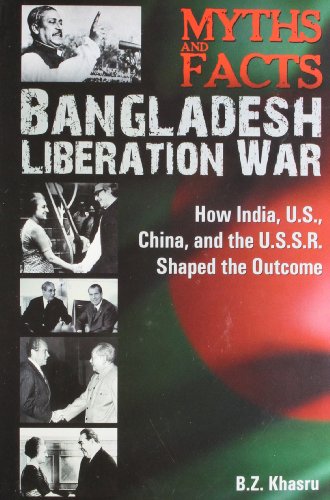
Myths and Facts Bangladesh Liberation War: How India, US, China, and the USSR Shaped the Outcome, by B.Z. Khasru

Download PDF Myths and Facts Bangladesh Liberation War: How India, US, China, and the USSR Shaped the Outcome, by B.Z. Khasru
Myths And Facts Bangladesh Liberation War: How India, US, China, And The USSR Shaped The Outcome, By B.Z. Khasru. A task could obligate you to consistently enhance the expertise as well as encounter. When you have no sufficient time to boost it directly, you can obtain the experience as well as expertise from checking out the book. As everybody understands, publication Myths And Facts Bangladesh Liberation War: How India, US, China, And The USSR Shaped The Outcome, By B.Z. Khasru is preferred as the window to open the world. It indicates that reviewing publication Myths And Facts Bangladesh Liberation War: How India, US, China, And The USSR Shaped The Outcome, By B.Z. Khasru will give you a new method to discover every little thing that you require. As the book that we will certainly provide right here, Myths And Facts Bangladesh Liberation War: How India, US, China, And The USSR Shaped The Outcome, By B.Z. Khasru
Checking out publication Myths And Facts Bangladesh Liberation War: How India, US, China, And The USSR Shaped The Outcome, By B.Z. Khasru, nowadays, will not compel you to constantly get in the establishment off-line. There is a fantastic place to get guide Myths And Facts Bangladesh Liberation War: How India, US, China, And The USSR Shaped The Outcome, By B.Z. Khasru by on the internet. This website is the very best website with great deals varieties of book collections. As this Myths And Facts Bangladesh Liberation War: How India, US, China, And The USSR Shaped The Outcome, By B.Z. Khasru will certainly remain in this book, all publications that you need will certainly correct below, too. Simply search for the name or title of guide Myths And Facts Bangladesh Liberation War: How India, US, China, And The USSR Shaped The Outcome, By B.Z. Khasru You could locate what exactly you are hunting for.
So, even you need commitment from the company, you may not be puzzled more considering that publications Myths And Facts Bangladesh Liberation War: How India, US, China, And The USSR Shaped The Outcome, By B.Z. Khasru will certainly always help you. If this Myths And Facts Bangladesh Liberation War: How India, US, China, And The USSR Shaped The Outcome, By B.Z. Khasru is your finest companion today to cover your task or job, you could when feasible get this book. Exactly how? As we have told recently, simply see the web link that we offer right here. The final thought is not only guide Myths And Facts Bangladesh Liberation War: How India, US, China, And The USSR Shaped The Outcome, By B.Z. Khasru that you hunt for; it is exactly how you will get numerous books to assist your ability as well as capability to have piece de resistance.
We will certainly reveal you the best and easiest means to get publication Myths And Facts Bangladesh Liberation War: How India, US, China, And The USSR Shaped The Outcome, By B.Z. Khasru in this globe. Great deals of collections that will support your task will be here. It will certainly make you really feel so ideal to be part of this internet site. Ending up being the member to consistently see what up-to-date from this publication Myths And Facts Bangladesh Liberation War: How India, US, China, And The USSR Shaped The Outcome, By B.Z. Khasru website will certainly make you feel best to look for the books. So, just now, as well as right here, get this Myths And Facts Bangladesh Liberation War: How India, US, China, And The USSR Shaped The Outcome, By B.Z. Khasru to download as well as wait for your precious worthy.
In the book, the author uncovers the mysteries surrounding the 1971 South Asian war. Using extensive research and thorough analyses, the author describes what caused the war, how it was conducted, and how the world powers shaped its outcome. Based on formerly secret US government documents that have been declassified and obtained under the Freedom of Information Act as well as stories narrated by those who made history before, during and after the conflict this book cracks open the floodgates of information, separating facts from myths and giving details of events as they unfolded during those fateful days of 1971. An exhaustive, well researched account of Bangladesh Liberation War its causes, its course and the culmination. An in-depth report validated and supplemented by formerly secret documents released by the US government. A brilliant attempt at sieving facts from myths related to the South Asian War of 1971. A compelling and an engaging read.
- Sales Rank: #2001412 in Books
- Published on: 2010-10-01
- Original language: English
- Dimensions: .0" h x .0" w x .0" l, 2.47 pounds
- Binding: Hardcover
- 462 pages
About the Author
B.Z. Khasru, an award-winning journalist, is publisher and editor of The Capital Express, a financial publication in New York. Previously, he was managing editor of The Business Journal and reporter for The Journal News, a Gannett daily in New York. He holds a master s degree in journalism from Northeastern University in Boston.
Most helpful customer reviews
4 of 5 people found the following review helpful.
"The birth of Bangladesh" despite US, China and Pakistan.
By T. R. Santhanakrishnan
The recent declassification of US Government archives has provided a rich mine of information on US behavior during the1971 war between India and Pakistan that liberated Bangladesh.
B Z Khasru, a US based journalist, has done extensive research of this newly declassified data to bring additional information about the 1971 events.
It was Bhutto, not Mujib, who broke Pakistan, says General Yahya Khan in an affidavit issued just before his death. All that Mujib-ur-Rahman wanted was for Bengal to have its fair share of growth, jobs, public purse and foreign aid; and the opportunity to grow through trade with India. Zulfikar Ali Bhutto had a tacit preference to let East Pakistan secede (and leave the West to be governed by Bhutto) than be subject to a weak federation ruled by Bengalis. Bhutto preferred power than Pakistan.
Yahya was no angel either. His motivation to conduct elections was the probability of getting to stay in power for a long period of time since his Intelligence officers advised him that the elections might not result in a clear majority and the framing of a new constitution within 120 days after the elections is unlikely. His allusion to Mujib as the future PM of Pakistan was more to scare the politicians in the West and the army to unite.
However, Khasru's book is more about how US misplaced its principles and misread the tea leaves.
Nixon and Kissinger saw the entire problem through the narrow prism of securing friendship with China through the benevolence of Yahya Khan.
1. The aspirations of 75 million people in the East and the genocide unleashed on them were not important. When US Consul at Dacca, Archer Blood, accused the US Government of "moral bankruptcy" for its "posture of pretending to believe Pakistan Government's false assertions", Nixon recalled Blood and transferred him to Personnel.
2. The focus was on keeping Yahya Khan pleased since he was the conduit to the secret parley with China. US would continue to publicly support Yahya's unified Pakistan; if East Pakistan requires US support, US would decline to give such a support "based on the premise that in US opinion West Pakistan would not use force to bring a solution".
Nixon and Kissinger were amazingly consistent in "misreading" the tea leaves:
1. Kissinger theorized that India would not want an independent Bangladesh since that would induce India's West Bengal province to secede from India and unite with Bangladesh!
2. Nixon preferred to support Pakistan wherever possible because "Yahya was more decent to US than Indira Gandhi was". Kissinger agreed, "Yahya was decent and reasonable if not politically smart".
3. Kissinger felt Indian occupation of Bangladesh would make Pakistan's look like child play. When Indian army entered Dacca, Nixon asked: "You see those people welcoming the Indian troops. Why then are we going through this agony?" Kissinger replied: "To prevent the West Pakistan army from being destroyed; to retain our Chinese arm; to preserve balance of power with the Soviet Union".
Nixon had a strong bias against India. In his private conversations with Kissinger, Indians were referred to as "cowards" and "savages". Nixon tried to support Pakistan in several ways:
1. When his State department disagreed with Kissinger that US owed arms support to Pakistan (when Pakistan invoked the bilateral agreement with US and sought arms), Nixon orchestrated provision through intermediary countries. Jordan did provide aircrafts and pilots to Pakistan. Iran agreed to but rescinded in the last minute. Kissinger admitted in 1972 to China that US supplied arms via third countries. The augmentation did not have an impact.
2. Nixon urged China to move troops to the Indian border saying "The Indians have got to get a little scared". China did not oblige because of its concerns about Soviet intervention under the Indo Soviet treaty.
3. Nixon moved US Seventh fleet to Bay of Bengal to increase threat perceptions though this did not have any impact on the war.
4. Nixon warned Soviet Union that any help to India would leave a scar in US-Soviet relationship for many years after the war ended. Nixon told a visiting Soviet minister: "The Indians are cowards. They are raping and murdering. They are pretty vicious". (Historians would consider this to be a Presidential lie). Kissinger felt Nixon's statement would make Soviets reduce their support to India. They did not.
In Khasru's book, Indira Gandhi emerges as a good leader. She worked on domestic opinion before supporting Mukti Bahini. She worked on international opinion before invading East Pakistan. She read the geopolitical scenario rightly and concluded a treaty with the Soviet Union to ensure China does not start any conflict to step up pressure against India. She was firm in declining to conform to UN resolution (orchestrated by Nixon) to ceasefire and withdraw from each other's territories (the usual end for every India Pakistan war in the past).
In the end it came down to Nixon and Kissinger not reading an important import of that amazing document, the Declaration of Independence in US: "Whenever any government becomes destructive of man's inalienable rights to life, liberty and pursuit of happiness, it was the right of the people to alter or abolish it".
0 of 0 people found the following review helpful.
Five Stars
By Shahriar Inam Reza
Received in great condition.
Myths and Facts Bangladesh Liberation War: How India, US, China, and the USSR Shaped the Outcome, by B.Z. Khasru PDF
Myths and Facts Bangladesh Liberation War: How India, US, China, and the USSR Shaped the Outcome, by B.Z. Khasru EPub
Myths and Facts Bangladesh Liberation War: How India, US, China, and the USSR Shaped the Outcome, by B.Z. Khasru Doc
Myths and Facts Bangladesh Liberation War: How India, US, China, and the USSR Shaped the Outcome, by B.Z. Khasru iBooks
Myths and Facts Bangladesh Liberation War: How India, US, China, and the USSR Shaped the Outcome, by B.Z. Khasru rtf
Myths and Facts Bangladesh Liberation War: How India, US, China, and the USSR Shaped the Outcome, by B.Z. Khasru Mobipocket
Myths and Facts Bangladesh Liberation War: How India, US, China, and the USSR Shaped the Outcome, by B.Z. Khasru Kindle
